
Bone Grafting & Ridge Augmentation in Pleasant Hill, CA
- Modern Technology
- Cosmetic Dentistry
- Personalized Care
- Crafted Smiles
- Natural Results
- Same-Day Solutions
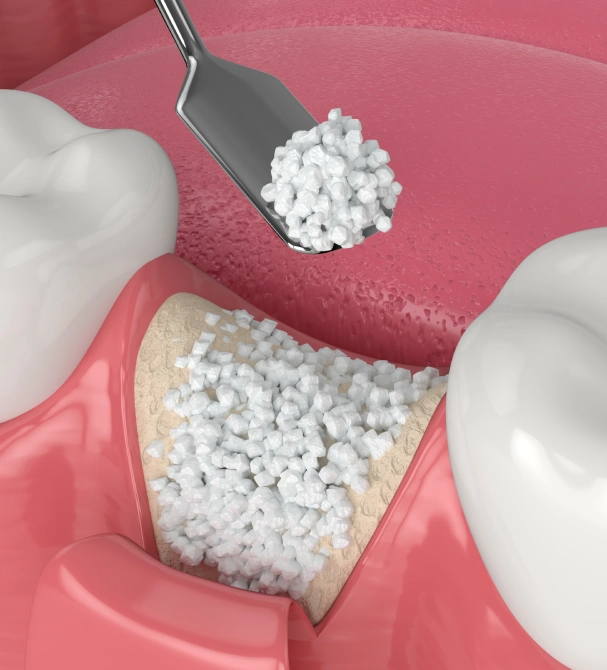
Rebuilding the Foundation Before Implant Placement
Dental bone grafting restores lost jawbone volume at an extraction site or atrophied ridge, creating the structural foundation needed for a dental implant to integrate successfully. Bone loss after extraction is immediate and progressive: the jaw begins reabsorbing within weeks of losing a tooth, and without intervention, that loss compounds over months and years. For patients in the East Bay who delayed tooth replacement while pushing through busy professional seasons, a move across the Contra Costa corridor, or years of deferred appointments during the pandemic, grafting is often what turns a situation that felt permanent into one with a clear path forward.
At Cosmetic Dental Spa Ricardo M. Perez, DDS, we provide dental bone grafts and ridge augmentation in Pleasant Hill, CA, as part of a restorative sequence designed to give implants the best possible foundation.
What Is Dental Bone Grafting?
Bone grafting introduces bone material to an area of the jaw where volume or density has been lost. The graft material, which may be derived from the patient’s own bone, a human donor source, an animal-derived matrix, or a fully synthetic material, serves as a scaffold that the body’s own bone-forming cells populate over time. As healing progresses, the graft integrates with the surrounding jaw tissue and builds new bone volume at the site.
Ridge augmentation is the application of grafting to rebuild the contour and height of the bony arch that once held the tooth roots. This is commonly needed when significant time has passed since extraction, when a tooth was lost to periodontal disease, or when the original extraction was done without a socket preservation graft at the time of removal. The augmented ridge then provides a stable base for implant placement once the graft has matured.
What Can Bone Grafting Address?
Post-Extraction Site Preservation
Grafting placed at the time of extraction minimizes the bone loss that would otherwise occur during healing. Socket preservation maintains the ridge’s original volume, simplifying subsequent implant placement.
Atrophied Ridge From Prolonged Tooth Loss
Patients who have been missing teeth for years without replacement often present with a significantly resorbed ridge. Ridge augmentation rebuilds the volume needed to house an implant at the correct depth and angulation.
Bone Loss From Periodontal Disease
Advanced gum disease destroys the bone that supports teeth. Before implants can be placed in periodontally compromised areas, the bone volume needs to be rebuilt and the periodontal environment stabilized.
Who Is Bone Grafting For?
Patients planning implant placement at a site where 3D imaging has confirmed insufficient bone volume or density
Anyone who has had a tooth extracted and wants to preserve the ridge for future implant placement
Patients with a diagnosis of periodontal bone loss need to be addressed before implant surgery
Individuals who had teeth removed years ago without socket preservation and are now considering implants
Patients completing a full-arch reconstruction who need site-specific augmentation before the full implant sequence begins
When Is Bone Grafting Not Needed?
Not every implant case requires grafting. Patients with adequate bone volume confirmed on CBCT imaging can proceed directly to implant placement without a preparatory graft. The imaging drives the recommendation.
You have adequate bone at the planned implant site
CBCT imaging confirming sufficient height, width, and density allows implant placement without grafting.
You are not pursuing implants
Bone grafting serves as the foundation for implant placement. If the patient’s plan involves a bridge, denture, or no tooth replacement, grafting is not indicated solely to address the bone loss.
Our Bone Grafting Process
3D Imaging and Volume Assessment
CBCT imaging measures bone height, width, and density at the planned implant sites. Imaging identifies exactly where grafting is needed and the volume augmentation required at the site.
Surgical Placement of Graft Material
The graft is placed at the deficient site under local anesthesia. Sedation is available for patients who prefer it.
Healing Period
Bone graft maturation typically takes three to six months, depending on the size of the graft and the patient’s healing response. Imaging at the end of the healing period confirms whether the site has reached the required volume for implant placement.
Implant Placement
Once grafting has matured sufficiently, the implant is placed into the rebuilt site, and osseointegration begins.
Before and After Your Appointment
Before Your Appointment
- Disclose all medications, particularly bisphosphonates used for osteoporosis, which affect bone metabolism and can significantly complicate grafting outcomes.
- Stop smoking before the procedure and plan to abstain through the healing period. Smoking impairs blood supply to healing tissue and substantially increases the risk of graft failure.
- Arrange transportation if sedation is planned. Plan to take the remainder of the day off following the surgical appointment.
After Your Appointment
- Eat soft foods and avoid direct pressure on the surgical site for at least a week. Do not probe the area with your tongue or fingers.
- Take any prescribed antibiotics for the full course, even if the area feels fine after the first few days.
- Swelling and mild bruising in the area are expected for several days and do not indicate a problem. Contact the office if swelling worsens after day three or if you develop a fever.
Why Choose Dr. Perez for Bone Grafting?
Grafting done well, with proper imaging, appropriate material selection, and precise placement, is what makes the implant that follows manageable. Done poorly or skipped when it was needed, it compromises everything placed on top of it. The treatment planning process at this practice begins with the imaging, not with a default protocol, and the graft recommendation reflects what the specific site actually requires.
Patients considering implants who have been told elsewhere that bone loss makes them ineligible often find, at a consultation with Dr. Perez, that grafting opens a path that was previously presented as closed.
Frequently Asked Questions
Is bone grafting painful?
The procedure is performed under local anesthesia. Postoperative soreness, mild swelling, and occasional bruising are common for several days. Most patients manage discomfort with over-the-counter anti-inflammatories and find the recovery more straightforward than anticipated.
Where does the bone graft material come from?
Graft material can be obtained from the patient’s own bone harvested from another site (autograft), processed donor bone (allograft), animal-derived bone matrix (xenograft), or fully synthetic materials (alloplast). The appropriate type depends on the size of the defect, the planned procedure, and clinical factors Dr. Perez will review with you.
Does Dr. Perez accept insurance?
Yes. Coverage for bone grafting varies significantly. Socket preservation at the time of extraction is covered by some plans. Larger ridge augmentation procedures are less consistently covered and may require documentation of medical necessity. The team reviews your benefits and provides an estimate before treatment begins.
How much does bone grafting cost?
Cost depends on the size of the area being grafted, the material used, whether a membrane is placed, and the complexity of the procedure. Factors include the number of sites grafted, imaging requirements, and any additional preparatory treatment needed.
The Right Foundation Determines The Next Steps
An implant placed in insufficient bone will likely be unstable. Grafting the site correctly before placement is what gives the implant the conditions it needs to integrate and last. At Cosmetic Dental Spa Ricardo M. Perez, DDS in Pleasant Hill, CA, the sequence is planned with the end result in mind. Schedule your consultation today.
Cosmetic Dental Spa Ricardo M. Perez, DDS
Dentistry Powered by Innovation
3D DIGITAL IMAGING
Cone beam imaging captures detailed three-dimensional views of teeth, roots, and bone that standard X-rays cannot provide.
CEREC SAME-DAY CROWNS
Chairside CAD/CAM technology designs and mills permanent ceramic crowns in the office, completing the entire restoration process in a single visit without temporaries or lab waiting periods.
Intra-oral Scanning
Digital impressions replace the discomfort of traditional impression trays with a quick, precise 3D scan of the teeth, supporting planning and accurate treatment previews.
Diode Laser Technology
Laser-assisted procedures enable precise gum contouring, soft tissue treatment, and selected periodontal procedures with reduced bleeding and faster healing.