Implant-Supported Dentures in Pleasant Hill, CA
- Modern Technology
- Cosmetic Dentistry
- Personalized Care
- Crafted Smiles
- Natural Results
- Same-Day Solutions
The Stability Traditional Dentures Cannot Provide
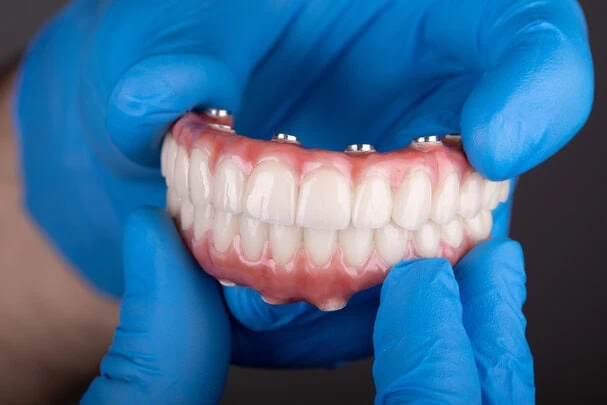
Implant-supported dentures attach directly to titanium posts anchored in the jawbone, eliminating the slipping, clicking, and dietary restrictions that come with conventional removable prosthetics. Standard dentures rest on the gumline and shift as bone gradually reabsorbs beneath them, a process that accelerates the longer teeth have been missing. For patients in the East Bay who have spent years managing that instability, declining certain dishes at dinners in Walnut Creek’s downtown restaurants or self-consciously adjusting before speaking in a group, implant anchoring changes what eating, speaking, and daily confidence look like in a practical and immediate way.
At Cosmetic Dental Spa Ricardo M. Perez, DDS, we provide implant-supported dentures in Pleasant Hill, CA, for patients who want a prosthetic that stays in place.
What Are Implant-Supported Dentures?
Implant-retained dentures use two to six titanium implants placed in the jaw as anchor points for a full-arch prosthetic. The denture either snaps onto the implants (a removable overdenture) or is fixed in place and can only be removed by the provider (a fixed implant bridge). Both approaches deliver significantly greater stability than a conventional denture that relies solely on suction, adhesives, or gum contact.
Because the implants transmit bite force directly into the bone, they preserve the jawbone in a way that a resting denture cannot. Bone loss under conventional dentures is progressive, eventually changing the fit of the prosthetic and the shape of the face. Implant anchoring interrupts that process.
What Can Implant-Supported Dentures Address?
Denture Instability During Eating and Speaking
Shifting prosthetics affects the ability to eat fibrous or crunchy foods and can create self-consciousness during conversation. Implant anchoring holds the denture firmly through normal chewing forces.
Ongoing Bone Loss Under Conventional Dentures
A denture that rests on the gumline provides no signal to the underlying bone to maintain its volume. Implants replicate the mechanical stimulation of tooth roots, slowing and in some cases halting the resorption cycle.
Sore Spots and Poor Fit From Resorbed Ridges
As the bone recedes, the ridge on which the denture rests changes shape. Implant anchoring bypasses the ridge entirely for stabilization, reducing the need for fit adjustments.
Dietary Restrictions From Conventional Prosthetics
Patients with unstable dentures routinely avoid foods that require sustained bite pressure. Implant-secured prosthetics restore the ability to eat with significantly less restriction.
Who Are Implant-Supported Dentures For?
Patients currently wearing conventional full dentures who are unhappy with stability, fit, or comfort
Anyone who has experienced progressive bone loss and is finding that denture adjustments are becoming more frequent
Patients who have had all teeth removed on one or both arches and want a fixed or more stable replacement option
Individuals who are good candidates for implant surgery based on bone volume assessment and medical history
Patients who want to reduce reliance on adhesives and are looking for a prosthetic that behaves closer to natural teeth
When Are Implant-Supported Dentures Not the Starting Point?
Bone volume is significantly insufficient
Extensive resorption may require grafting before implants can be placed. This extends the timeline but does not rule out candidacy in most cases.
Active systemic conditions are uncontrolled
Diabetes, autoimmune conditions, and certain medications affect osseointegration. Medical stabilization precedes surgical planning.
The patient prefers a fully removable prosthetic
For patients who want the simplest possible maintenance routine and do not mind daily removal, a well-fitted conventional denture with regular monitoring may better match their preferences.
Our Implant-Supported Denture Process
Bone Assessment and Imaging
CBCT imaging evaluates bone density and volume at the planned implant sites. This determines how many implants are needed, their positions, and whether preparatory grafting is required.
Implant Placement
Titanium posts are placed surgically under local anesthesia, with sedation available. A healing period follows while osseointegration occurs, typically three to six months.
Prosthetic Fabrication and Attachment
Once the implants have integrated, abutments are placed, and the custom denture is fabricated and fitted. Attachment hardware is adjusted to confirm proper seating, retention, and bite alignment.
Follow-Up and Maintenance
Regular follow-up appointments confirm implant health, prosthetic fit, and bone maintenance. Removable overdentures require periodic inspection of attachment hardware; fixed prosthetics are evaluated like natural teeth at every cleaning.
Before and After Your Appointment
Before Your Appointment
- Bring your current denture to the consultation. It provides a useful reference for the shape and occlusal relationship your replacement needs to replicate or improve on.
- Disclose all current medications, especially bisphosphonates, blood thinners, and immunosuppressants, which affect surgical candidacy and healing.
- If you smoke, plan for cessation before and during the healing phase. Implant failure rates are meaningfully higher in active smokers.
After Your Appointment
- Eat soft foods for the first week after implant placement. Avoid direct chewing pressure on the surgical sites until the provider clears you for a normal diet.
- Clean around implant abutments with the tools recommended at your appointment. Standard brushing is not enough to prevent peri-implant infection.
- Contact the office promptly if you experience unusual pain, worsening swelling after day three, or any movement in the implants.
Why Choose Dr. Perez for Implant-Supported Dentures?
Treatment with Dr. Perez is planned from the bone up. The combination of CBCT imaging, restorative design experience, and a clear patient communication process means patients understand exactly what they are agreeing to before any procedure begins.
For patients who have visited other practices and received conflicting information about their candidacy, a consultation at this practice provides a clear assessment based on actual imaging. The Contra Costa area patients who pursue treatment with us consistently cite the transparency of the process as the reason they chose it.
Frequently Asked Questions
What is the difference between implant-supported dentures and traditional dentures?
Traditional dentures rest on the gumline and rely on suction or adhesive for retention. Implant-anchored prosthetics attach to titanium posts in the jawbone, providing stability that does not depend on ridge contact or adhesive.
How many implants are needed for implant-supported dentures?
The minimum is typically two implants for a lower arch overdenture. Upper arch cases generally require more, often four, because the upper bone is less dense. The exact number depends on bone volume, prosthetic design, and the forces the restoration needs to withstand.
Does Dr. Perez accept insurance?
Yes. Coverage for the prosthetic component varies more than coverage for the implants themselves. The team reviews your specific plan before treatment begins.
How much do implant-supported dentures cost?
Cost depends on the number of implants, whether grafting is required, the type of prosthetic (overdenture versus fixed bridge), and the fabrication complexity. Factors affecting your total cost include arch selection, imaging, and any preparatory procedures needed before placement.
Stability That Changes What Eating and Speaking Feel Like
Cosmetic Dental Spa Ricardo M. Perez, DDS
Dentistry Powered by Innovation
3D DIGITAL IMAGING
Cone beam imaging captures detailed three-dimensional views of teeth, roots, and bone that standard X-rays cannot provide.
CEREC SAME-DAY CROWNS
Chairside CAD/CAM technology designs and mills permanent ceramic crowns in the office, completing the entire restoration process in a single visit without temporaries or lab waiting periods.
Intra-oral Scanning
Digital impressions replace the discomfort of traditional impression trays with a quick, precise 3D scan of the teeth, supporting planning and accurate treatment previews.
Diode Laser Technology
Laser-assisted procedures enable precise gum contouring, soft tissue treatment, and selected periodontal procedures with reduced bleeding and faster healing.